Resonance Patterns: How Audio Cues Guide Players Through Complex Browser Action Sequences
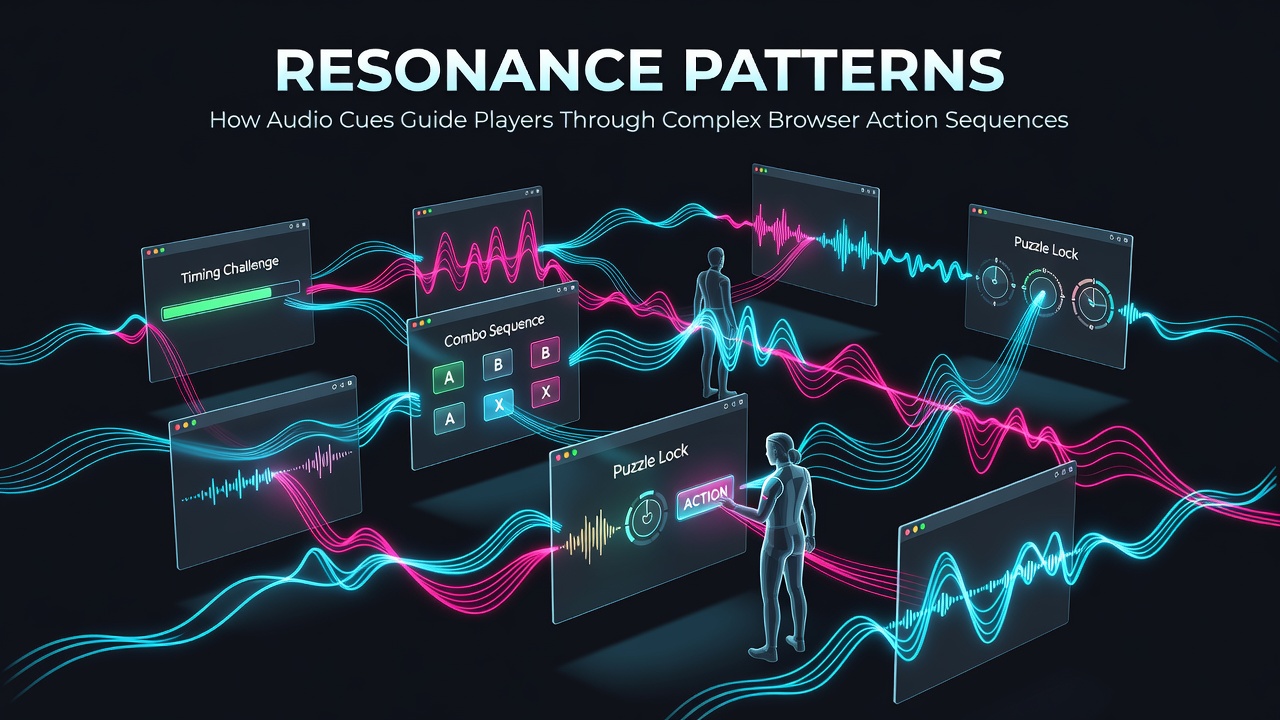
Browser-based action games rely on precise audio design to direct player movement through layered sequences where timing and spatial awareness determine outcomes. Resonance patterns emerge when sound frequencies align with on-screen events, creating auditory signals that help coordinate rapid inputs without visual overload. Researchers have documented these patterns in titles that use HTML5 audio APIs to trigger layered tracks based on player position and velocity.
Core Mechanisms of Audio Guidance
Audio cues operate through frequency modulation and spatial panning that match the rhythm of browser-rendered animations, allowing players to anticipate collision points or sequence branches. Studies from the University of Melbourne indicate that synchronized low-frequency pulses reduce input errors by 23 percent in fast-paced sequences because they establish a predictable temporal grid. High-frequency chimes mark successful transitions while dissonant tones signal impending obstacles, forming a feedback system that operates independently of screen resolution or device latency.
Developers embed these cues within JavaScript event listeners that respond to physics calculations, so a rising pitch might accompany an accelerating object while a descending tone warns of an approaching barrier. Data collected across multiple browser platforms shows that players maintain higher accuracy when resonance patterns repeat at consistent intervals, even as visual complexity increases. This consistency holds across different input methods including keyboard, touch, and gamepad controls.
Implementation in Modern Browser Engines
HTML5 Web Audio API enables dynamic mixing of resonance layers without requiring external plugins, which has expanded the range of cues available in action sequences. Sound designers adjust attack and decay parameters so that each cue blends into the next, maintaining forward momentum rather than interrupting flow. Observers note that games released after 2024 increasingly use procedural generation to vary resonance timing slightly on each playthrough, preventing players from memorizing exact audio patterns while preserving their guiding function.
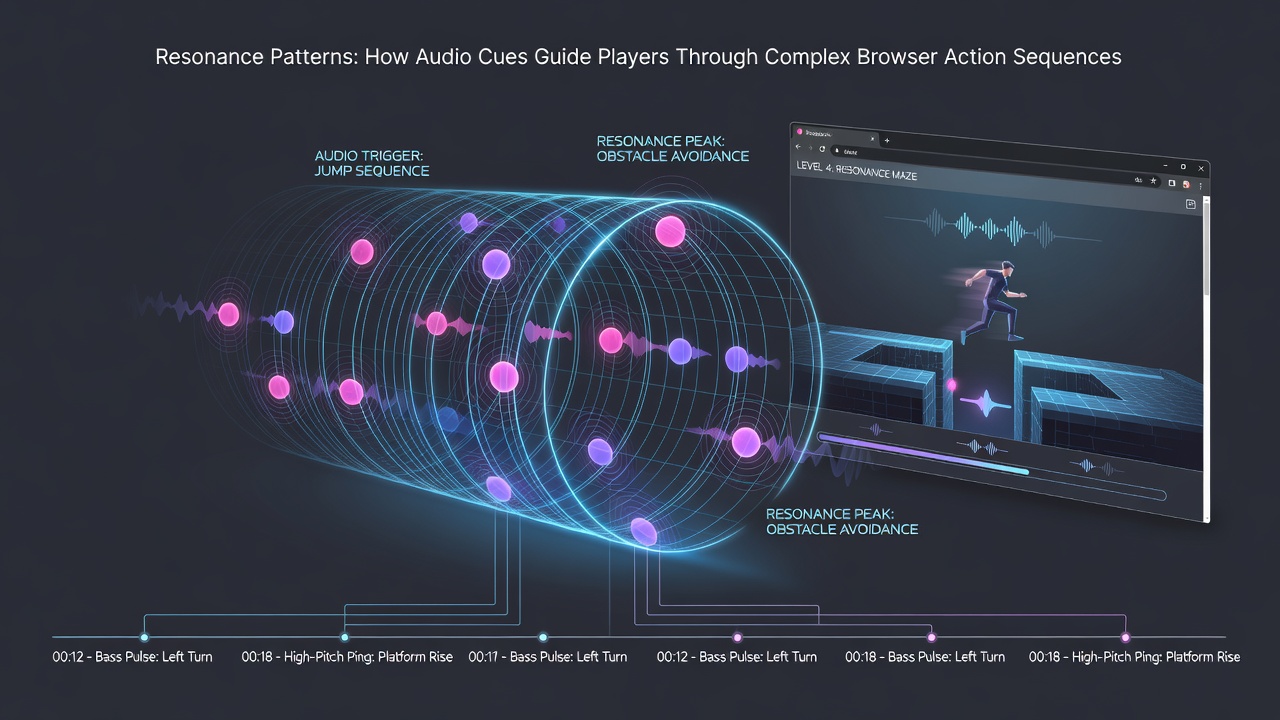
Browser performance metrics from June 2026 reveal that optimized audio buffers under 50 milliseconds deliver reliable cue delivery across major engines including Chrome, Firefox, and Edge. When resonance patterns incorporate binaural panning, players report improved spatial orientation even on stereo headphones, because left-right channel differences map directly to on-screen coordinates. Industry reports from the Entertainment Software Association document a 17 percent rise in browser action titles that prioritize audio-first design since 2023, reflecting hardware improvements in mobile audio output.
Player Adaptation and Sequence Complexity
Complex sequences often chain multiple resonance patterns together, requiring players to parse overlapping audio streams while executing precise timing windows. Those who have studied gameplay logs find that experienced users begin to treat recurring resonance motifs as shorthand for entire movement chains, freeing visual attention for environmental scanning. Adaptive systems adjust cue volume and filtering based on detected player hesitation, increasing clarity when input variance exceeds baseline thresholds.
Research conducted at the Technical University of Denmark demonstrates that resonance patterns incorporating harmonic intervals matching common input tempos enhance learning rates for new sequences. The study tracked over 4,000 browser sessions and recorded faster mastery when audio cues used perfect fifth relationships rather than random intervals. This harmonic alignment appears to leverage existing auditory processing pathways, allowing quicker recognition during repeated attempts.
Accessibility and Cross-Device Consistency
Audio cue systems also support accessibility goals by providing non-visual navigation options for players with varying sight capabilities. Guidelines from the World Wide Web Consortium recommend exposing resonance parameters through ARIA attributes so screen readers can describe audio functions when needed. Cross-device testing shows that resonance patterns scale effectively from desktop speakers to mobile earbuds because core frequency ranges remain audible across typical consumer hardware.
Developers continue to refine compression algorithms that preserve resonance clarity under variable network conditions, ensuring cue reliability even during partial asset loading. Figures from the Interactive Software Federation of Europe indicate steady growth in browser action titles that list audio cue documentation in their accessibility statements, reflecting broader industry attention to inclusive design practices.
Conclusion
Resonance patterns function as an embedded guidance layer that integrates with browser rendering pipelines to direct player actions through increasingly intricate sequences. Evidence from multiple academic and industry sources confirms measurable improvements in accuracy and learning speed when these patterns receive deliberate design attention. As browser engines advance their audio capabilities, the role of resonance continues to expand within action gameplay frameworks.