Latency Legends: Connection Speeds Shaping Competitive Edges in Multiplayer Web Strategy Games

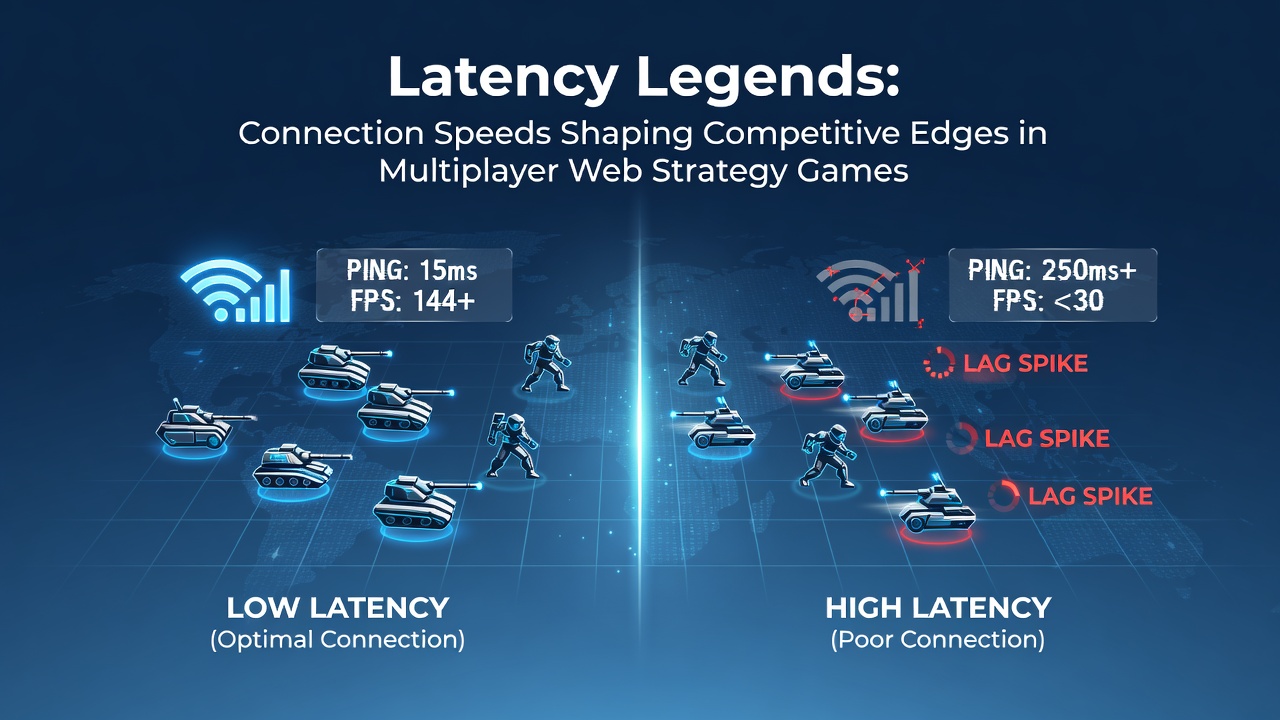
Browser-based multiplayer strategy games have grown into arenas where connection speeds directly influence outcomes, and researchers have documented how latency differences create measurable advantages during matches. Players issue commands for unit movements, resource allocations, and defensive setups through web interfaces that rely on consistent data transmission, which means delays of even 50 milliseconds can shift the timing of critical actions.
Core Mechanics Affected by Network Performance
Real-time strategy titles hosted in browsers process simultaneous inputs from multiple participants, and studies from institutions such as the University of Waterloo indicate that higher ping values disrupt the synchronization of these inputs. Observers note that participants with connections under 30 milliseconds often execute build orders and counter-moves before opponents with 80-millisecond averages complete their turns, which alters the pace of resource gathering and combat resolution in games that blend turn-based planning with live execution.
Data from industry reports compiled in early 2025 shows average latency thresholds across popular titles hover between 40 and 120 milliseconds depending on server distribution, yet regional variations persist because infrastructure quality differs by continent. European players frequently encounter lower baseline figures than those in remote areas of Asia or South America, and these disparities compound when matches involve cross-continental participants.
Quantifiable Edges in Match Results
Figures from competitive logs reveal that players maintaining sub-50-millisecond connections secure victory rates approximately 12 to 18 percent higher in prolonged sessions compared with those above 100 milliseconds, according to aggregated analytics shared by the Interactive Games and Entertainment Association based in Australia. Such patterns appear consistently in titles where fog-of-war mechanics and simultaneous movement orders require precise timing, because delayed packets force participants to rely on predictive algorithms that sometimes misalign with actual opponent positions.
One documented tournament series held in May 2026 incorporated latency compensation tools, and results demonstrated that standardized ping equalization narrowed outcome gaps but did not eliminate them entirely when hardware differences remained. Participants adapted strategies around known delay profiles, which included prioritizing defensive structures over aggressive expansions when higher latency was anticipated.
Server Infrastructure and Regional Disparities
Web strategy platforms deploy distributed server nodes to reduce travel time for data packets, and reports from the Canadian Interactive Digital Entertainment Association highlight how North American clusters achieve average response times 25 milliseconds lower than equivalent setups in parts of Africa. Those who've examined traffic patterns observe that fiber-optic backbones and peering agreements between providers account for most of these reductions, while satellite or mobile connections introduce variability that strategy players must factor into long-term planning.
June 2026 saw several platforms announce expanded node placements in Southeast Asia, and preliminary measurements suggest these additions lowered median latency by 35 milliseconds for regional users. Such upgrades allow tighter coordination during large-scale battles where dozens of players issue overlapping commands within the same few seconds.
Adaptation Strategies Among Participants
Competitors have developed techniques to mitigate latency effects, including preemptive queuing of actions and selection of server regions that balance ping against opponent distribution. Research published through academic channels at the Technical University of Munich demonstrates that players trained on variable-delay simulators improve decision accuracy by 22 percent when returning to standard matches, because they learn to compensate for packet loss patterns without overcorrecting.
Browser APIs continue to incorporate features such as WebTransport protocols that prioritize low-latency streams for game state updates, and adoption rates among major titles reached 60 percent by mid-2026 according to tracking data from the Entertainment Software Association in the United States. These protocols reduce jitter compared with older WebSocket implementations, yet they still depend on underlying network stability.
Conclusion
Connection speeds continue to define competitive margins in multiplayer web strategy games through direct effects on command timing and synchronization, and ongoing infrastructure investments plus protocol improvements are reshaping how widely these advantages distribute. Data collected across regions confirms that lower latency correlates with higher success rates, while adaptation methods and server expansions provide pathways for broader participation. As browser technology advances, the interplay between network performance and strategic execution remains a central factor tracked by analysts and participants alike.